A view can remain ambiguous. A warning can change its own evidence. A convincing result can be selected from noise.
These three worked examples ask what makes a return informative. Each visual comes from an executable model. Use the controls to inspect the assumptions that make its result possible.
Exact model results and established methods are identified below. No human experiment or claim of a distinct advantage for the philosophy is presented.
The bounded program is complete: six models, ten exportable figures, and a final synthesis. The three sections below each lead to a deeper interactive experiment.
01 / OBSERVATION
The next view may need a different question.
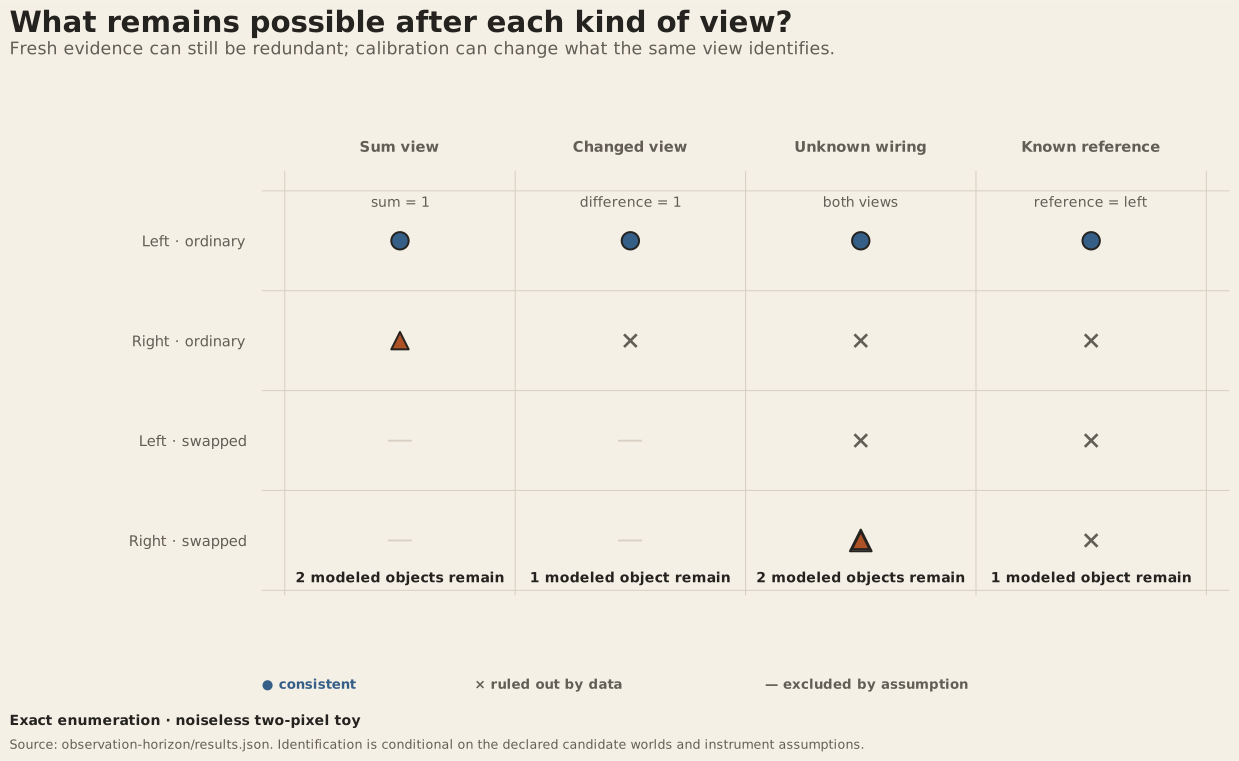
Galileo's successive views of Jupiter helped distinguish moons from fixed stars. Saturn's changing appearance posed another difficulty: understanding what the telescope could show. Our two-pixel model isolates that difference without pretending to reconstruct the historical telescope.
Left object
Right object
Scroll sideways to inspect the full figure at reading size.
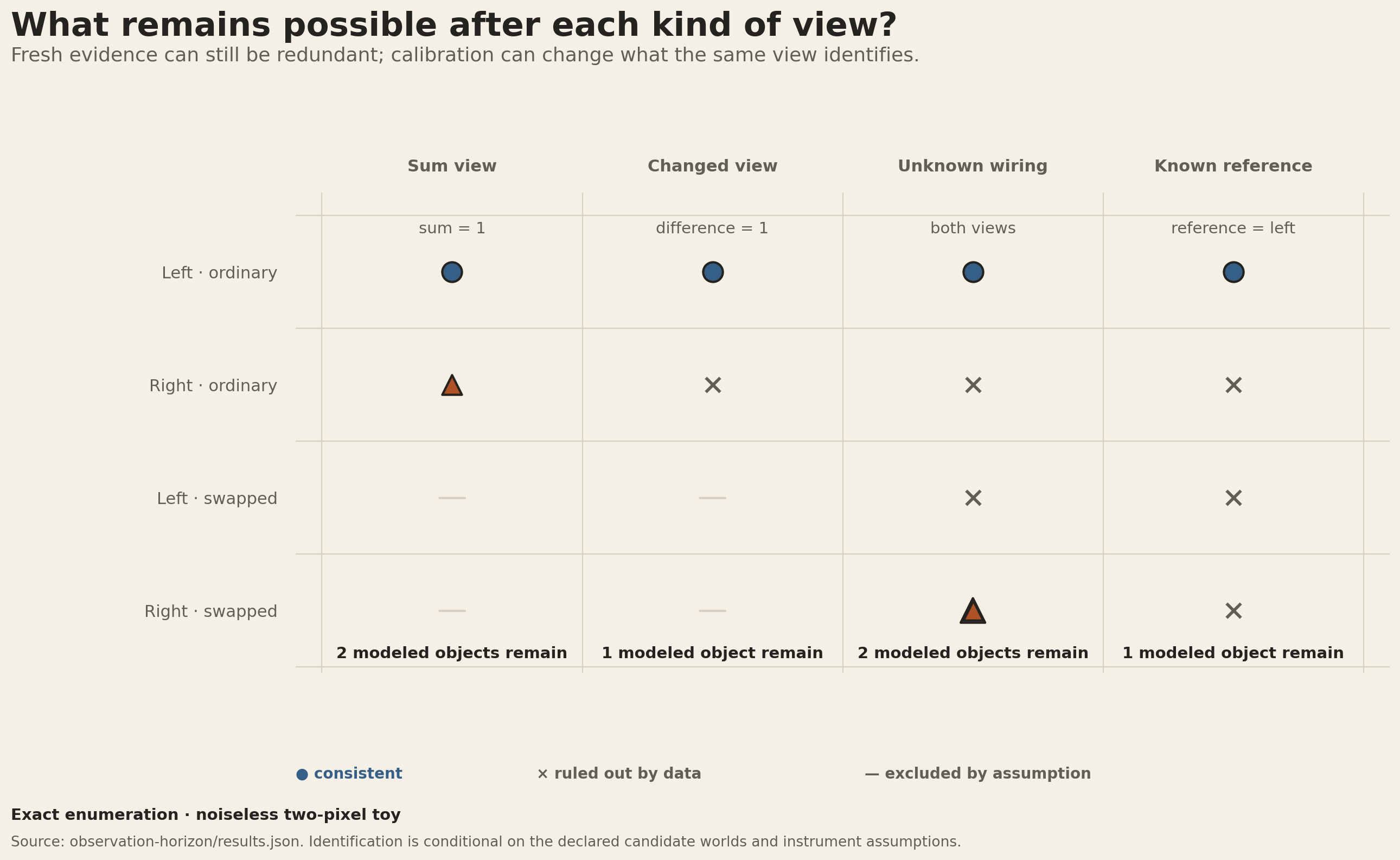
What remains possible after each kind of view? research/observation-horizon/results.json
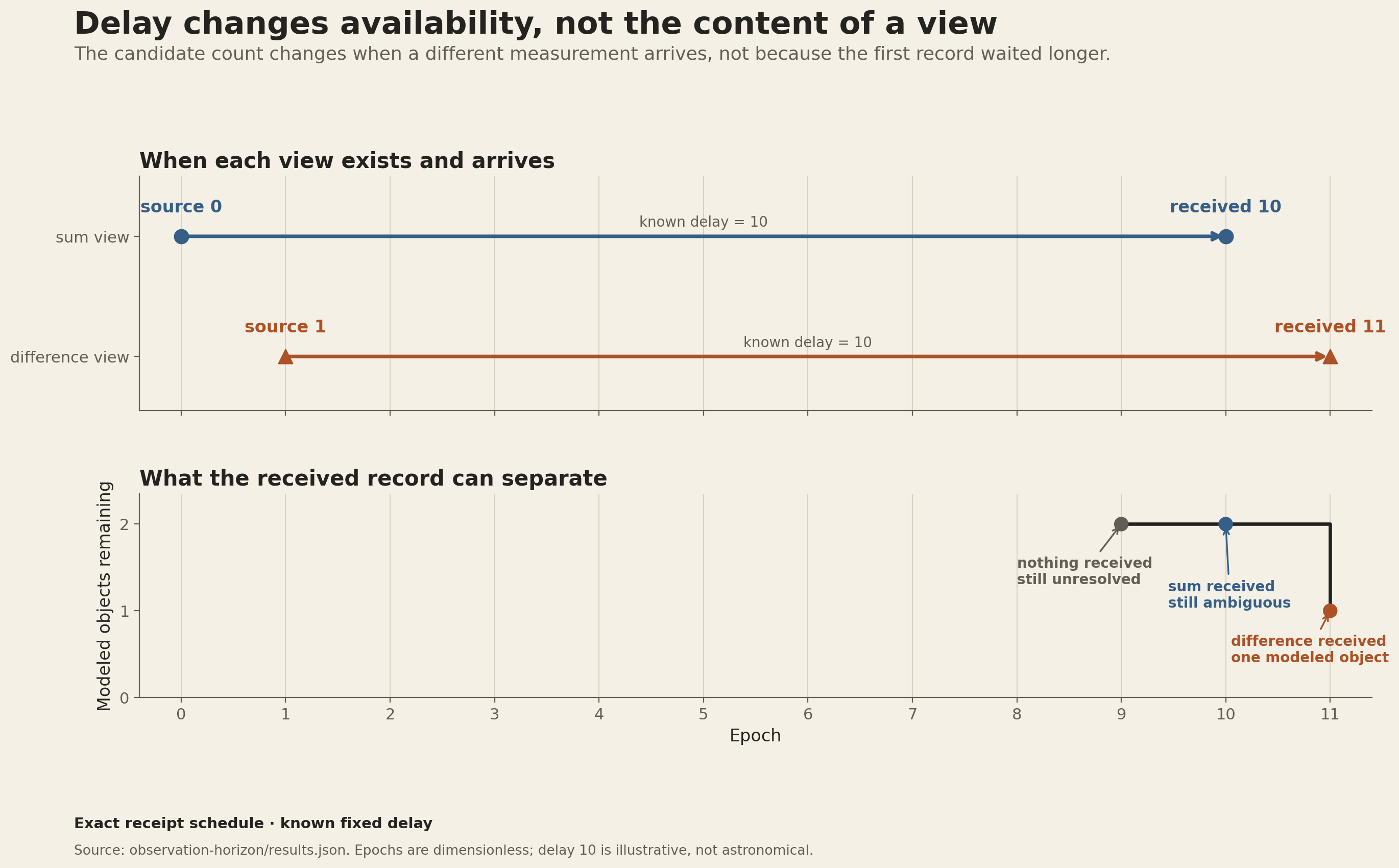
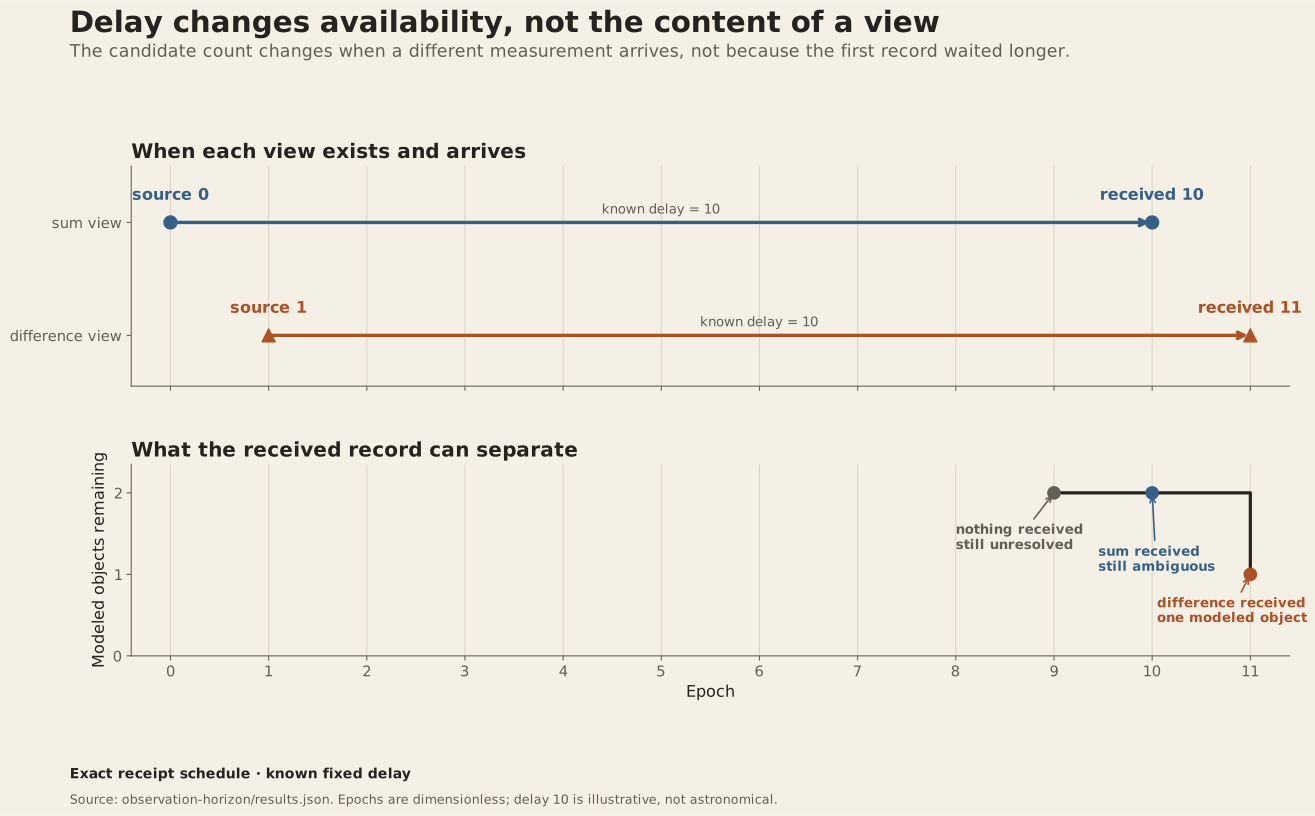
A later observation helps here when the measurement changes what it can distinguish. Receiving a delayed record is a separate matter: its arrival changes what is available to the observer, without changing the record's content.
Scroll sideways to inspect the full figure at reading size.
Delay changes availability, not the content of a view. research/observation-horizon/results.json
There are only two static objects. Even source epochs measure total brightness; odd epochs measure left minus right. Measurements are noiseless. A fixed unknown wiring swap can preserve ambiguity across every view; a known left-hand reference through the difference channel resolves it. No amount of this reasoning establishes that real observations exhaust all possible objects or instrument faults.
Repeated noisy observations can improve precision. An old record can also yield a new implication. Neither possibility is denied by this noiseless example.
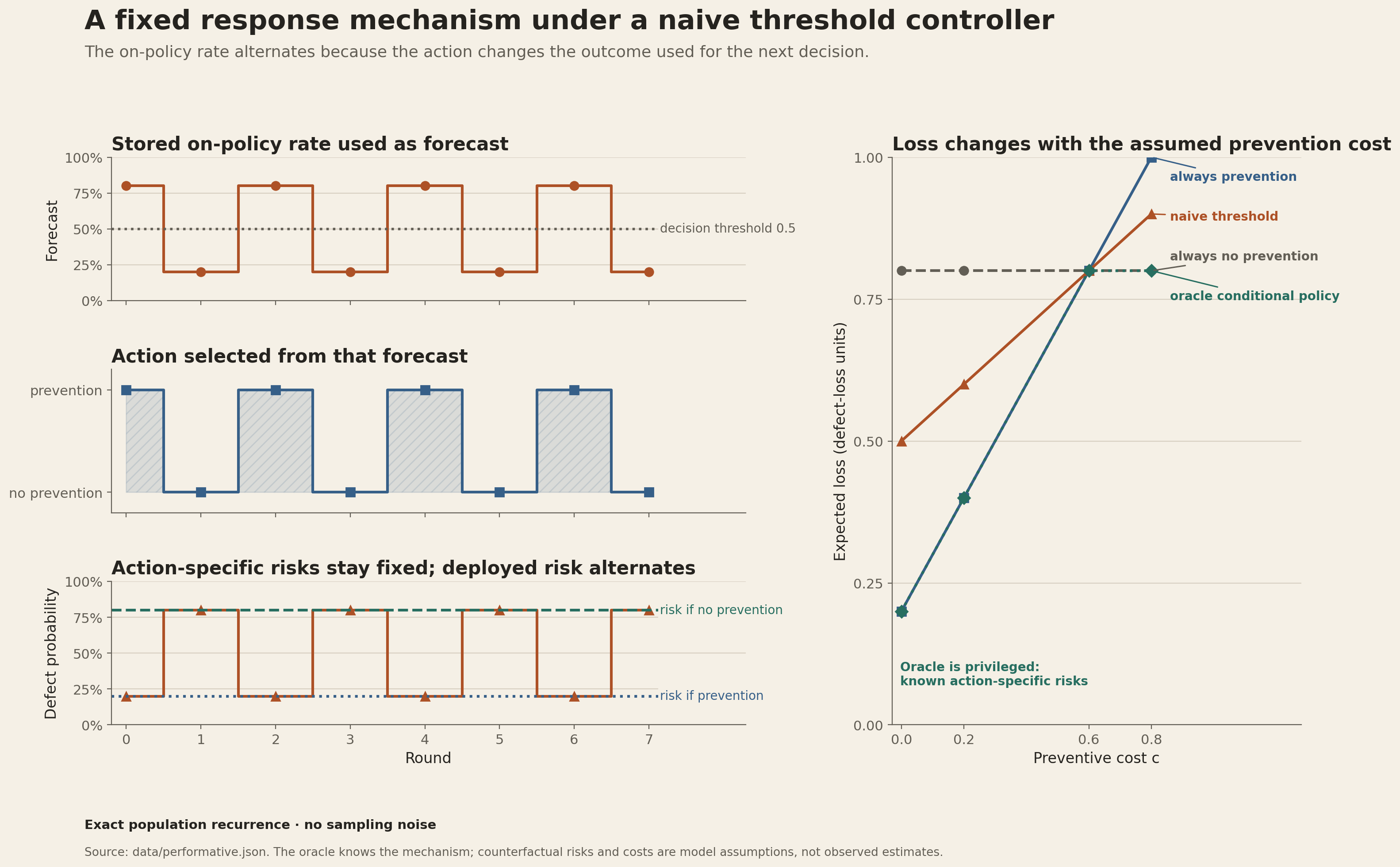
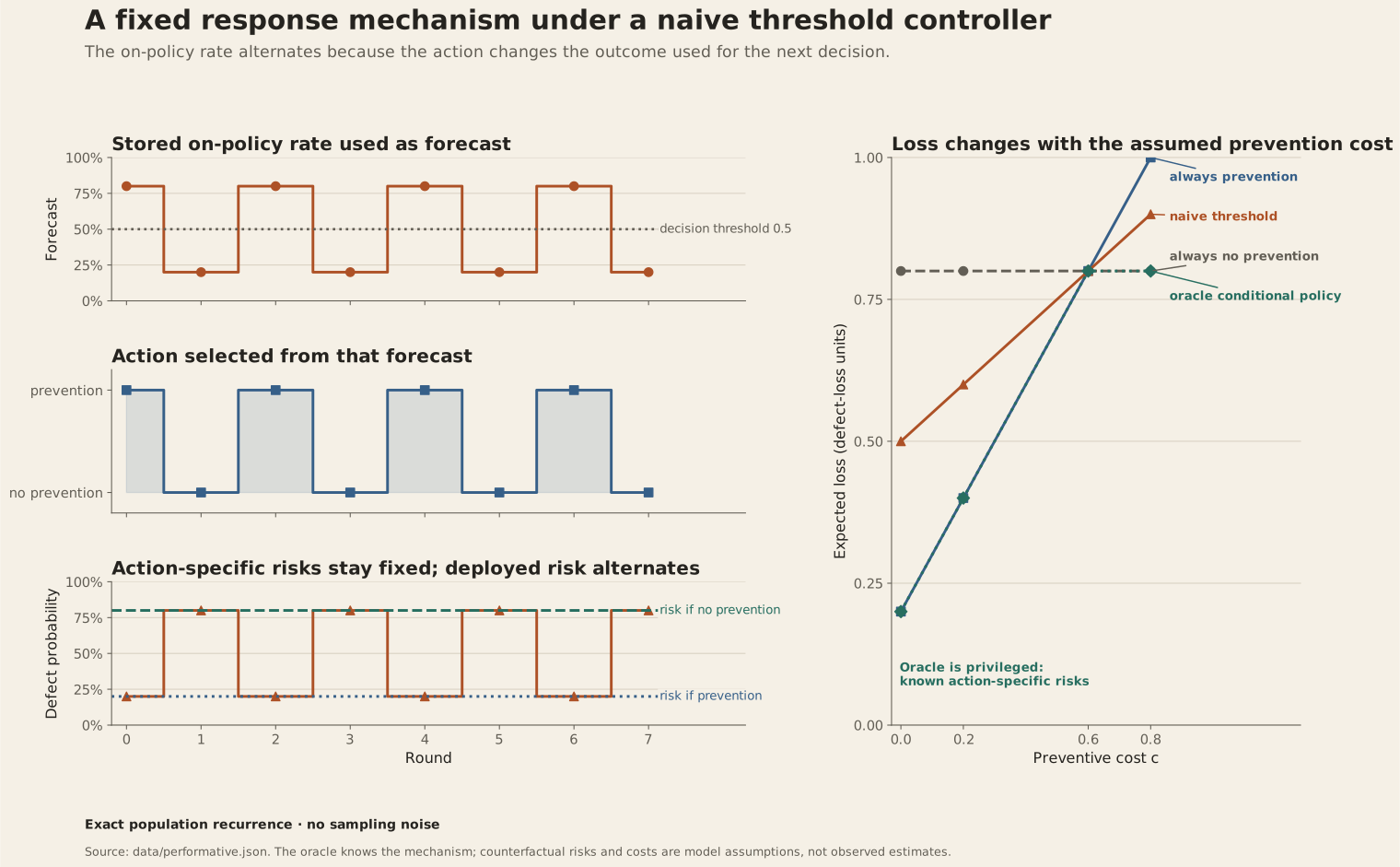
In this exact recurrence, prevention reduces defects from 80% to 20%. A controller uses the last observed rate to decide whether prevention is needed. When defects fall, it removes prevention. When they rise, it restores it. The response mechanism stays fixed throughout.
Scroll sideways to inspect the full figure at reading size.
A fixed response mechanism under a naive threshold controller. research/visual-inquiry/data/performative.json
The conditional reference knows both action-specific risks. It is an oracle comparison, not a learner given the same information. Lower expected loss follows only under the displayed objective: defect probability + prevention cost.
“What happened after we acted?” and “What would happen if we stopped?” can have different answers.
Inspect the causal and decision assumptions
The controller intervenes when its carried-over rate is at least 50%. For a baseline risk b, preventive effect e, and threshold τ, a two-cycle occurs when b − e < τ ≤ b. There is no sampling noise or mechanism drift. The equality convention matters.
An observed outcome under one action does not by itself identify the outcome under another. Action variation, causal knowledge, or another justified source is needed. A lower defect rate does not settle the cost or value of preventing defects.
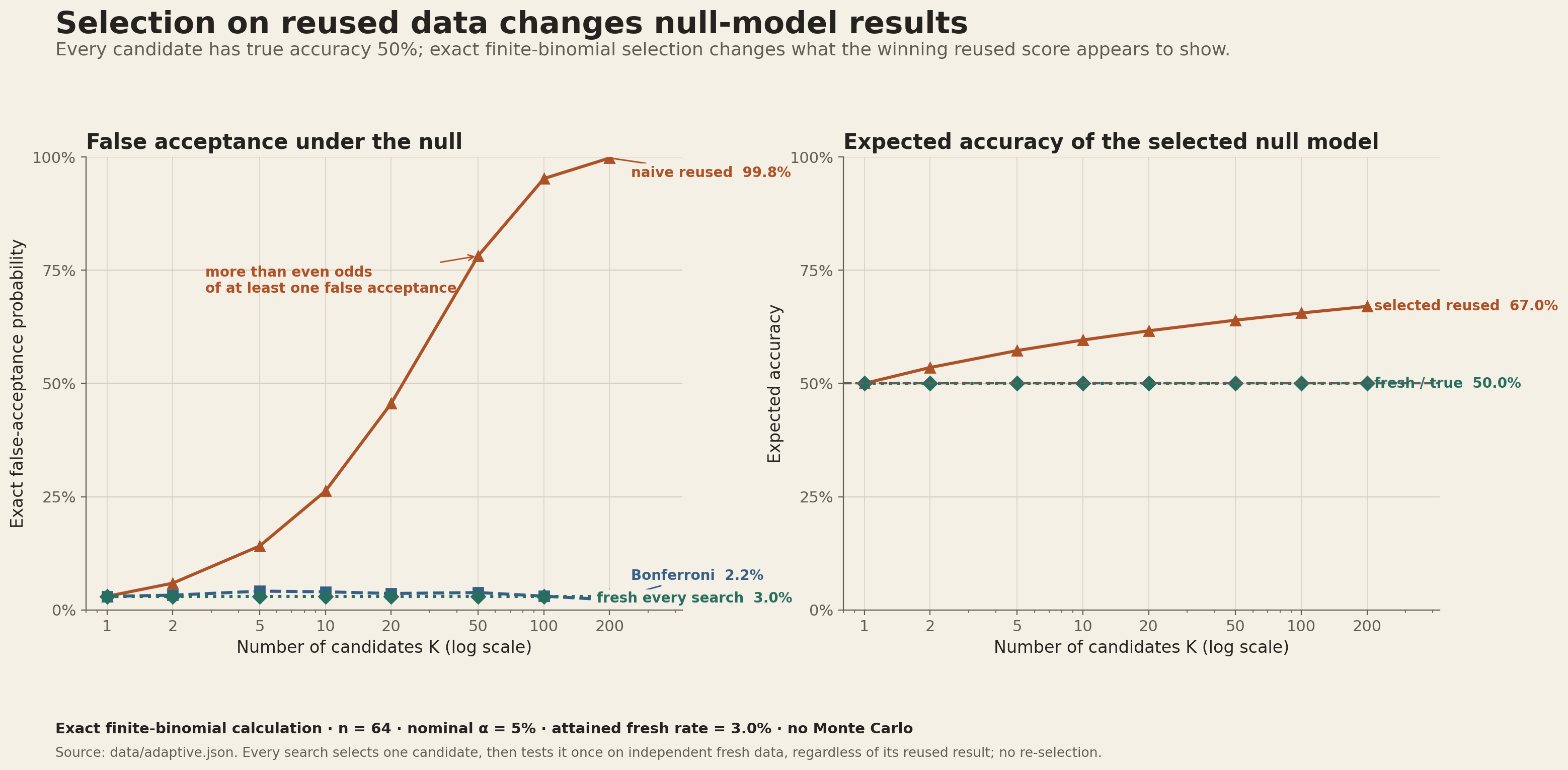
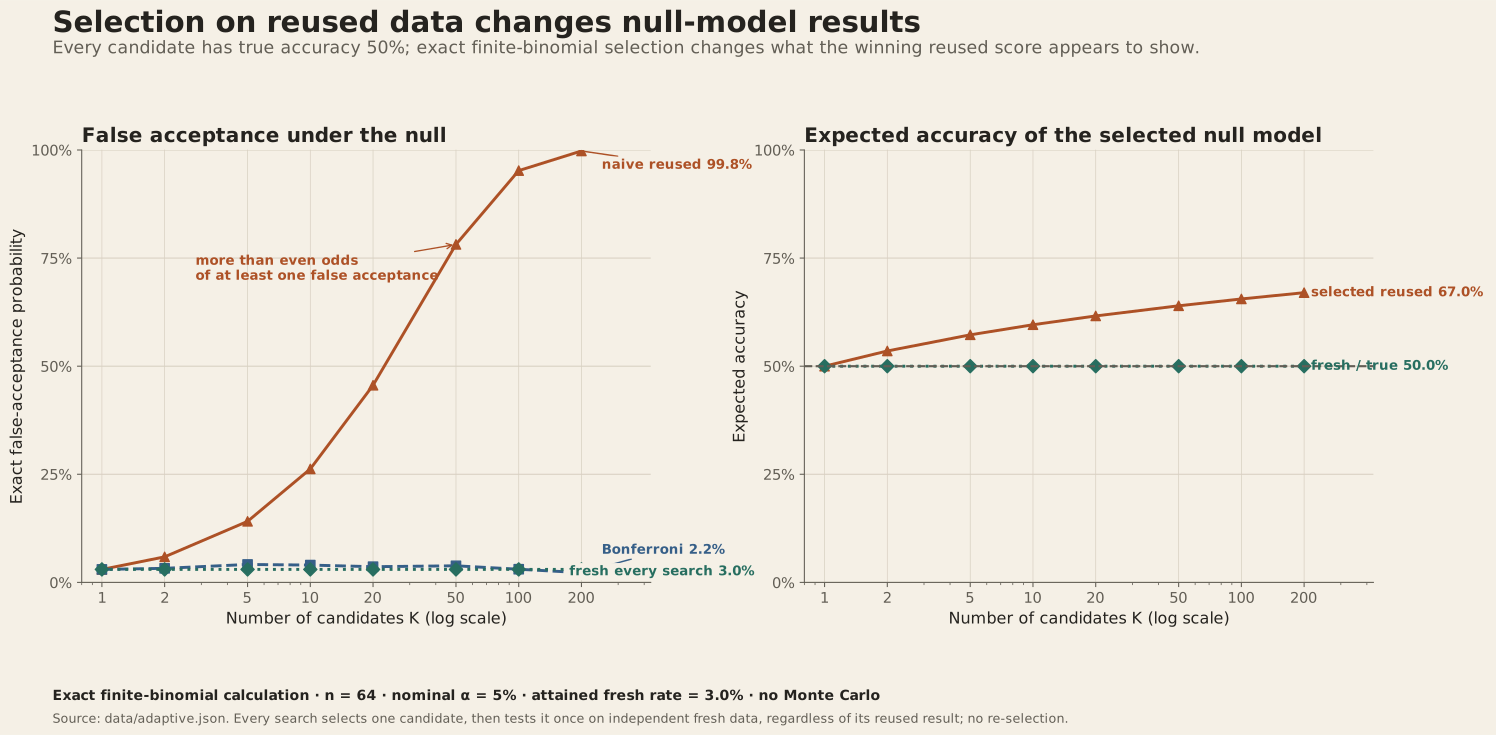
Every candidate in this example has true accuracy of 50%. Each is scored on 64 evaluation items. We select the candidate with the highest score, then compare what that selected score suggests with what an untouched evaluation would show.
Expected winning accuracy on the reused evaluation
Expected accuracy of that winner on untouched data
Chance the search yields a false acceptance using the unadjusted test
How the claim is evaluated
False-acceptance probability per search
Scroll sideways to inspect the full figure at reading size.
Selection on reused data changes null-model results. research/visual-inquiry/data/adaptive.json
A multiplicity correction accounts for the searched family. A fresh test evaluates the already selected candidate once, using evidence independent of that selection. These protect different stages of inquiry. Neither is a license to continue selecting after looking at the final result.
Inspect the statistical assumptions
The calculation uses independent Binomial(64, 0.5) counts, exact inclusive upper-tail tests, and a fixed family of candidates. The nominal 5% single-test threshold is 40 correct answers; its attainable false-positive rate is about 2.997%, because counts are discrete. Bonferroni uses 0.05 divided by the number of candidates.
Each probability is per complete search under an all-null model. The fresh-test row evaluates one selected winner for every search; it is not restricted to searches that first passed the reused test. The fresh evaluation is independent and used once. Real models can have correlated errors, and this example does not reproduce a general adaptive analysis or the private reusable-holdout method.
A loop can keep returning the answer it has made easiest to receive. The three extensions make different failures visible. This map compares their mechanisms; it is an interpretation of the models, not another measured result.
A sharper image
What can still be unresolved
The object and the instrument's wiring can change together while preserving the recorded evidence.
What the next inquiry needs
A constraint that distinguishes calibration histories. More of the same protocol cannot diagnose this reversal.
The framework holds that truth becomes actual as recognition through a living sensor and an instrument. These models contain no experiencers. They press on a narrower inference: a human's presence does not itself establish that the available record distinguishes the relevant alternatives.
An unexpected pattern can earn the next question before it earns belief in its answer.
This leaves two distinct questions: what became meaningful or transformative in the encounter, and what can distinguish its proposed explanation from the alternatives? The first can change which scientific question matters enough to pursue. It does not, by itself, settle the second.
The proposed CE practice is to connect a change in meaning or consequence to a revised question, a live alternative and a discriminating next step. It needs a comparison with an equally resourced human–instrument practice already using strong scientific methods. None of these models demonstrates an advantage for CE.
The full synthesis develops the argument, the causal connection to the “handshake,” and a remaining pressure on Doc III's treatment of beauty. Three questions remain for Alex's return:
When recognition happens, what changes: truth, knowledge, meaning, or our relation to an already true proposition?
Can an encounter be alive and transformative while its external explanation is false? If so, what distinguishes recognition from conviction?
What result would show that the proposed CE practice adds nothing to a strong existing method?