When repetition makes
the wrong answer stronger.
Repeated readings reduce noise. They do not establish that the calibration still holds.
Two possible objects. Two wiring orientations. Every measurement has an independent 15% chance of returning the wrong sign. This exact model asks how to spend a limited number of acquisitions—and what happens when one assumption fails.
← Three threads notebook · Read the argument and derivation · Claim-to-evidence ledger
A sharper reading can
leave the object ambiguous.
A difference measurement combines the object's side with the wiring orientation. Without a reference, “left with ordinary wiring” and “right with swapped wiring” predict the same signs. Repetition sharpens that combined sign while the object remains uncertain.
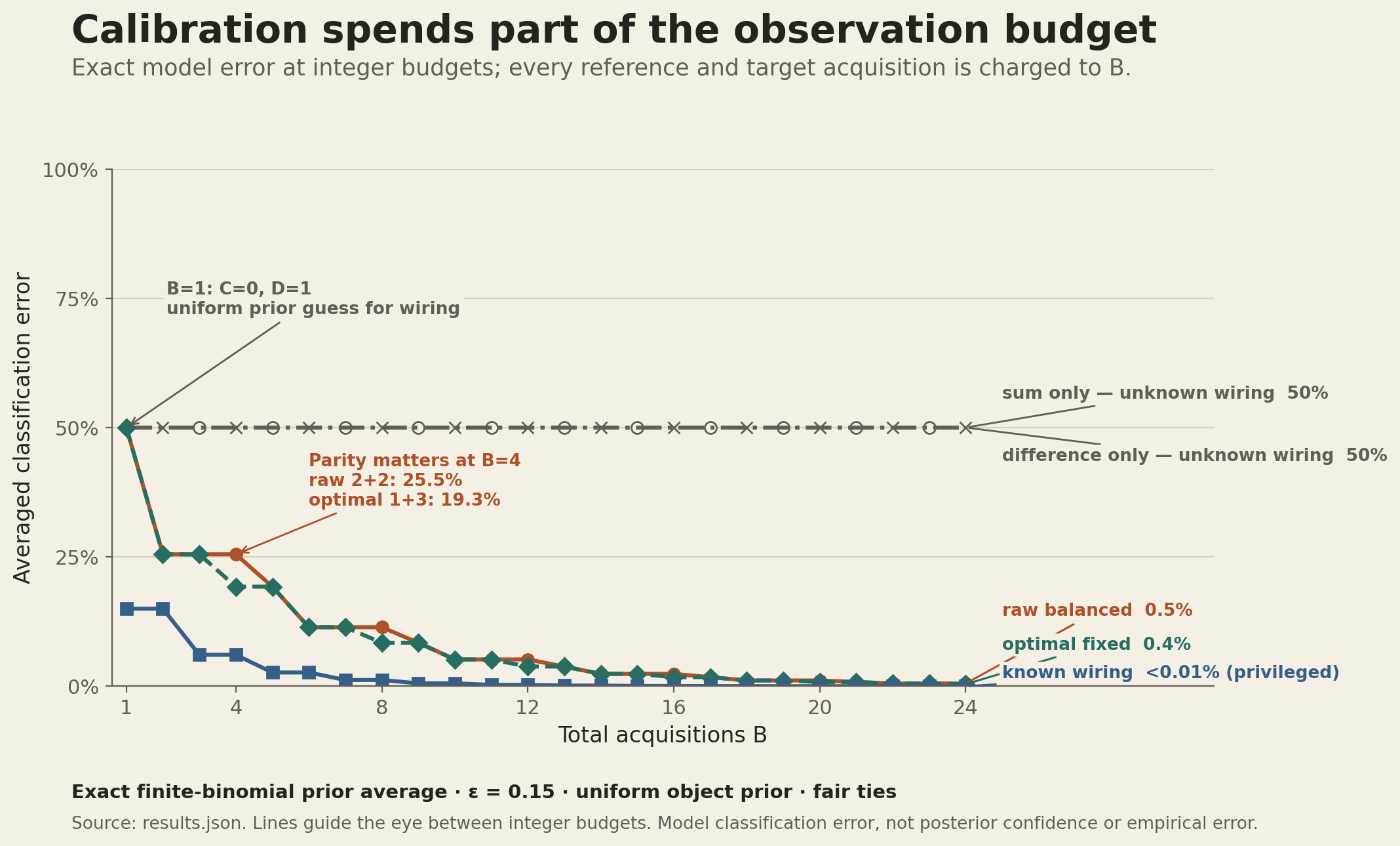
A known left-hand reference estimates the wiring. Combining calibration with object measurements reduces classification error. Both count against the budget.
| Design chosen before observing | Calibration + target | Object error |
|---|
The known-wiring reference receives orientation without spending acquisitions. It is a privileged comparison. All other designs start with equal probabilities for both objects and both orientations. These are exact average errors over noise and prior worlds, not error estimates from a sample.
Scroll sideways on a narrow screen to read the full figure.

Why the allocation sometimes favors an uneven split
With a fair coin on a tie, two readings have the same average binary-decision error as one. At budget four, splitting two and two yields 25.5% object error; one and three yields 19.2525%. The best fixed allocation is found by evaluating every split in advance. The model does not compare sequential adaptive allocation or measure time and financial costs.
The same rule,
a different wiring history.
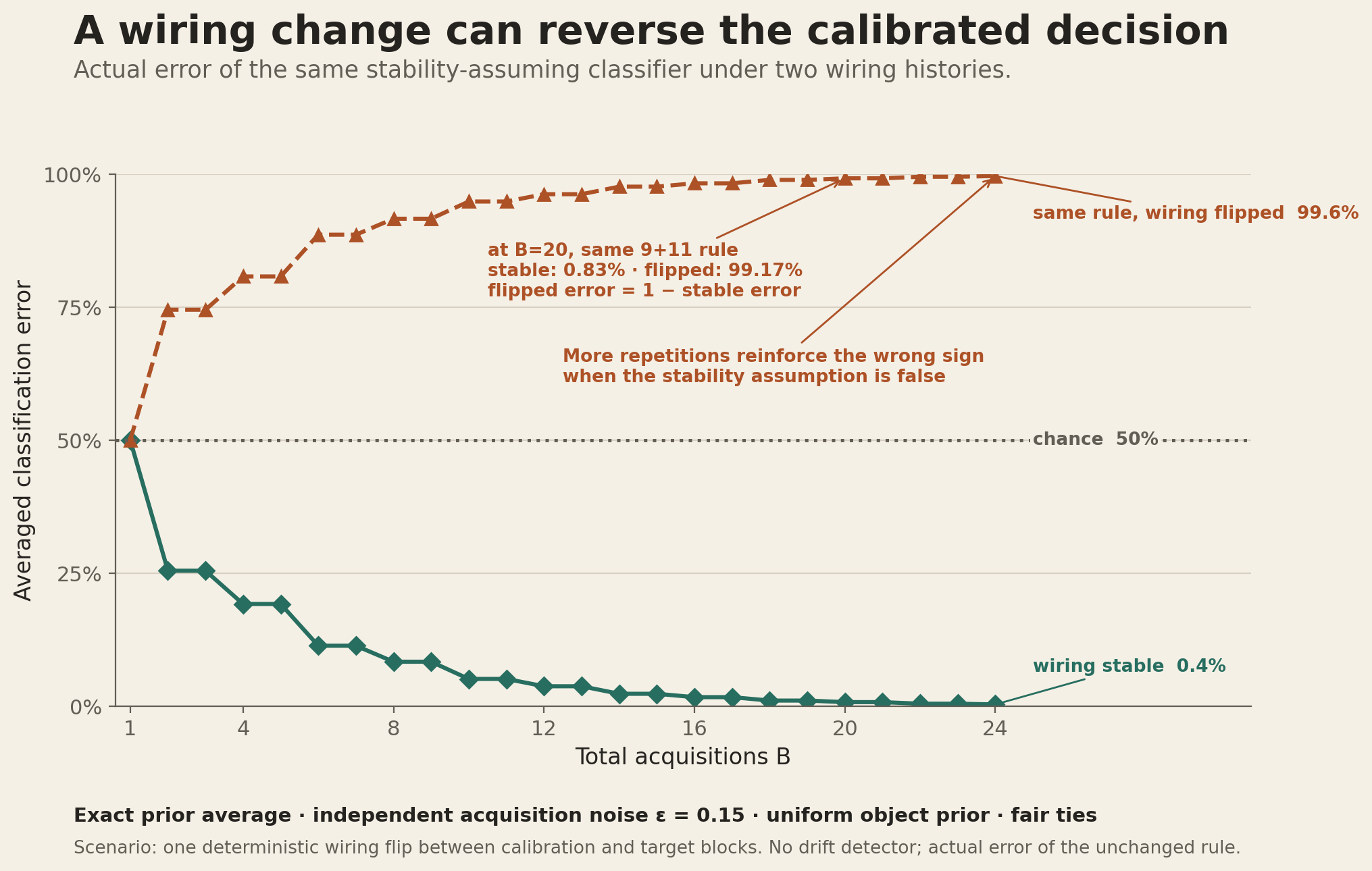
Now flip the wiring between the calibration block and the object block. The inference rule is unchanged: it assumes the wiring stayed fixed. The records then have exactly the distribution of the opposite object under stable wiring.
This is a failure of the stability assumption. An analyst informed of the flip could correct for it. No detector based only on these records can distinguish the two named worlds.
Scroll sideways on a narrow screen to read the full figure.

The return may need to challenge the observing arrangement itself. A check at the target stage would introduce another measurement protocol and cost; it is not supplied free to the model.
Confidence is conditional
on what the model allows.
One selected record: 10 positive calibration signs, followed by 10 negative object signs.
This example uses a 10 + 10 split, separate from the best-allocation curve. It is an illustrative record, not the average error above. Its probability conditional on either named world is ; the two conditional probabilities are exactly equal.
The framework's claim concerns truth becoming actual through living recognition. This model contains a physical detector and an inference rule; it does not contain the living sensor. It gives a precise challenge to any shortcut from a convincing return to a warranted object claim.
Calibration and continuing checks already have a place in measurement science. The proposed philosophical contribution is to make the relation between the return and the claim explicit—and revisable. Whether that adds a useful practice beyond established methods remains to be tested.