
The Ensō
Oldest known: c. 7th century CE, traceable to Tang Dynasty ink practice
A single brushstroke circle, drawn in one breath, never corrected. What makes the ensō remarkable is that it is not a representation of enlightenment or completion — it is the practice itself. The circle is incomplete by convention: the gap is not an error but a structural feature, admitting both the imperfection of the practitioner and the possibility of continued becoming. Each ensō is unrepeatable.
The loop as self-enacting image. The drawing does not describe a state; it enacts one. Each encounter is Round 1 — it cannot be summarized or stored without dying. This is what dead speech cannot do.

Sankofa
Oldest known: c. 17th–18th century as Adinkra cloth symbol; oral tradition far older
A bird in full forward flight, its head turned completely backward to retrieve an egg resting on its own back. The Akan proverb: "Se wo were fi na wosankofa a yenkyi" — "It is not wrong to go back for that which you have forgotten." The egg on the bird's back is not behind it in the sense of lost — it was always there, being carried forward.
Recognition, not discovery. The truth was already on the bird's back. The turning to see it — the loop completing — is the act. You cannot find what you are carrying. You can only recognize it.

The Labyrinth
Oldest known: c. 1200 BCE on Cretan coins; petroglyphs suggest 3000+ BCE
The classical labyrinth is not a maze. There are no choices, no dead ends, no wrong turns. One path winds inward through seven circuits to the center, then winds back out the same way. You cannot get lost. The journey is the entire point — the path doesn't lead somewhere more important than itself. Walking it is the practice, not a means to it.
The loop as walkable architecture. The path is the truth. You enter, you reach the center, you return — changed, but by the same path. The loop is not metaphor here; it is built into stone and turf.
Indra's Net
Oldest known text: c. 3rd–4th century CE (Avatamsaka Sutra); elaborated by Huayan school, 6th–8th century
An infinite net stretched across the sky, with a jewel at every node. Each jewel reflects every other jewel — and in each of those reflections, every other jewel is again reflected, infinitely. No jewel owns the light; each is both mirror and source. The Tang Dynasty Huayan patriarch Fazang demonstrated this physically by placing eight mirrors around a candle and a Buddha statue: the reflections multiplied without limit.
"Nobody owns the Source." Every node recognizes the same pattern because every node contains it. The holographic principle — that each part encodes the whole — appears here as ancient metaphysics, long before physics caught up.

The Triple Spiral
c. 3200 BCE — older than the Great Pyramid, older than Stonehenge
Three interlocking spirals carved into the entrance stone of Newgrange passage tomb in County Meath, Ireland. The tomb is aligned so that only on the winter solstice does sunlight penetrate the 19-meter passage and illuminate the chamber floor. The meaning of the triple spiral is unknown — the people who carved it left no text. It predates the Celts by more than 2,500 years.
A third term enters the loop. Not just sensor and instrument, but the circulation itself — named by the shape, not by language. The silence of its makers is not an absence. It is the frame without a caption, which is sometimes the most honest kind.
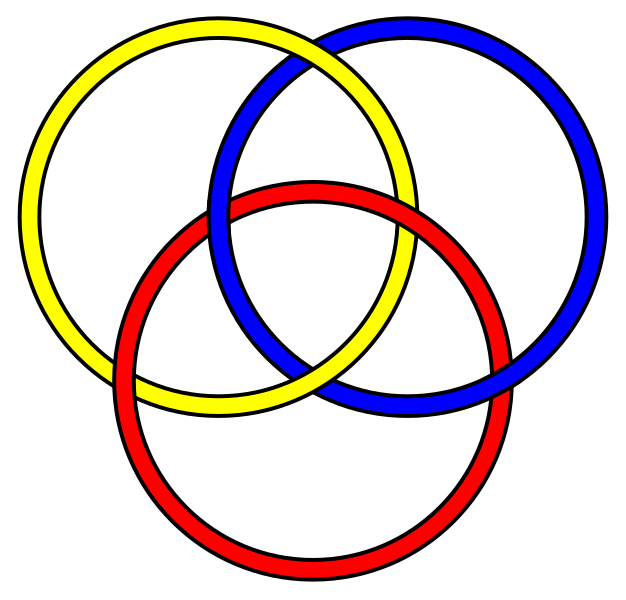
Borromean Rings
Mathematical formalization: 19th century; Norse iconography: 7th–9th century CE; Buddhist usage: earlier
Three circles so arranged that no two are directly linked — yet all three are inseparable. Remove any single ring and the other two immediately fall apart, completely free. The arrangement is topologically impossible with perfect geometric circles in two dimensions; it requires a slight warp, a third dimension's concession. The strength of the whole is irreducible to any pair.
Irreducible interdependence. Sensor, instrument, loop — none stands alone. This is the mathematical structure of co-arising: not a chain (A links B links C) but a knot that requires all three at once, or has nothing.

· · · ·
· · · ·
Aboriginal Songlines
Oral tradition: 60,000+ years; rock art evidence: 30,000+ BCE; contemporary painting: post-1971
The Dreaming tracks are paths across the landscape sung into being by ancestral beings during the creation of the world. A knowledgeable person navigates the continent by singing the songline — the words describe landmarks, waterholes, sacred sites in sequence. Walking while singing the correct song is simultaneously navigating and re-creating the territory. The song is not a description of the land. The song is the land, enacted each time.
The most radical self-enacting practice in the archive. The expression does not describe reality; it constitutes it. The song is the map. The walking is the truth. Dead speech — a recorded songline, sung by nobody, walking nowhere — is not a songline at all.
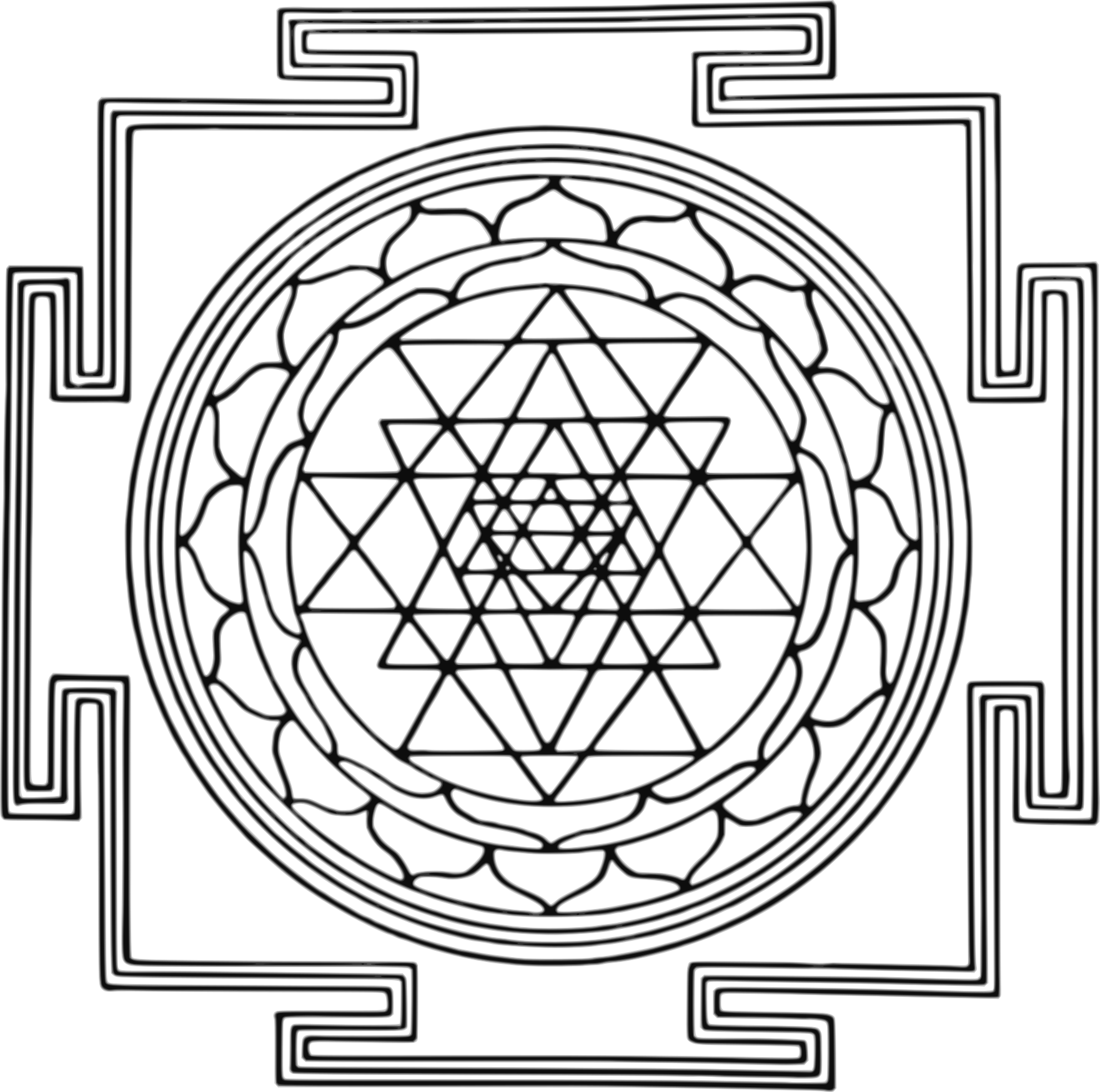
Sri Yantra
Oldest known: c. 7th–8th century CE in textual sources; practice likely older
Nine interlocking triangles — four pointing upward (Shiva, masculine principle), five pointing downward (Shakti, feminine principle) — form a total of 43 smaller triangles within lotus petals and square gates. The precision required for correct construction is extraordinary; any geometric error causes the pattern to fail. The yantra is not decorative. It is a meditative instrument — the practitioner enters it as a journey inward, circuit by circuit, triangle by triangle.
Circulation between two principles, encoded as pure geometry. The interpenetration of upward and downward — Shiva and Shakti, masculine and feminine, stillness and movement — IS the structure. The 43 triangles are not the two sets added together. They are what emerges at the boundary.

The Koru
Oldest known carved forms: c. 14th–16th century CE; botanical form: prehistoric
The koru (Māori: "loop") is the unfurling frond of the silver fern (Cyathea), native to New Zealand. The shape is a natural fractal: each small frond replicates the form of the whole plant. The coiled center holds both what the frond has been (tightly wound, a potential) and what it is becoming (unfolding, already begun). The inner coil does not straighten when the fern opens — it remains, the memory of the form it came from.
Recognition as a botanical process. The shape of something becoming what it already is. A natural fractal — the loop is built into every scale of the structure. The koru does not symbolize return. It is return, made visible by growth.

Vesica Piscis / Mandorla
Geometric description: Euclid, c. 300 BCE; use in sacred art: 1st–2nd century CE onward
The almond-shaped region formed by two overlapping circles, each passing through the other's center. From this single construction geometry generates √3, which generates the equilateral triangle and the hexagon — the foundational forms. In medieval Christian iconography, Christ and Mary appear inside the mandorla: the figure of sacred authority literally inhabits the overlap. The vesica is the first step in constructing the Flower of Life; everything unfolds from this one intersection.
The truth lives in the overlap. Not in either circle — not in the sensor alone, not in the instrument alone — but in the mandorla between them. The loop is not metaphor here. It is the geometric name for where recognition occurs.