The Collective Veer
What happens to a loop when the sensor is replaced by a crowd — and the crowd starts listening to itself instead of the world.
collective_loop.py simulates a population of N Kuramoto phase oscillators — a crowd, a dancefloor, a committee, an ensemble of coupled minds — trying collectively to track an external drive: the beat, the territory, the truth the room is supposed to be tuned to. Each oscillator has its own natural frequency, the crowd's mean tempo is detuned from the drive, and every oscillator feels a weak pull toward the drive (EPS) and a pull toward the rest of the crowd (internal coupling K). The experiment sweeps K from 0 (a room of strangers) to large (a crowd moving as one) and asks a single question:
As a collective couples more tightly to itself, does it track the world better or worse?
The headline result: a phase transition into the Veer
There is a critical internal coupling K* (≈ 0.7 in the reported regime) above which the collective abruptly stops tracking the external beat and locks to its own tempo:
| regime | phase-locking to the drive (PLV) | collective frequency | reading |
|---|---|---|---|
K < K* (loosely coupled) |
0.98 | the drive's tempo (0.0) | entrained to the world — the beat leads |
K > K* (tightly coupled) |
0.41 | a tempo of its own (≈ 0.28; the crowd's natural tempo is 0.4) | locked to itself — the beat still drags its tempo partway but can no longer capture it |
Internal synchronization r rises smoothly through the transition (0.4 → 1.0); the loss of grounding is abrupt. The crowd does not feel itself going deaf — by every internal measure it is getting more coherent, more unanimous, more confident. What collapses is invisible from inside: the channel to the world.
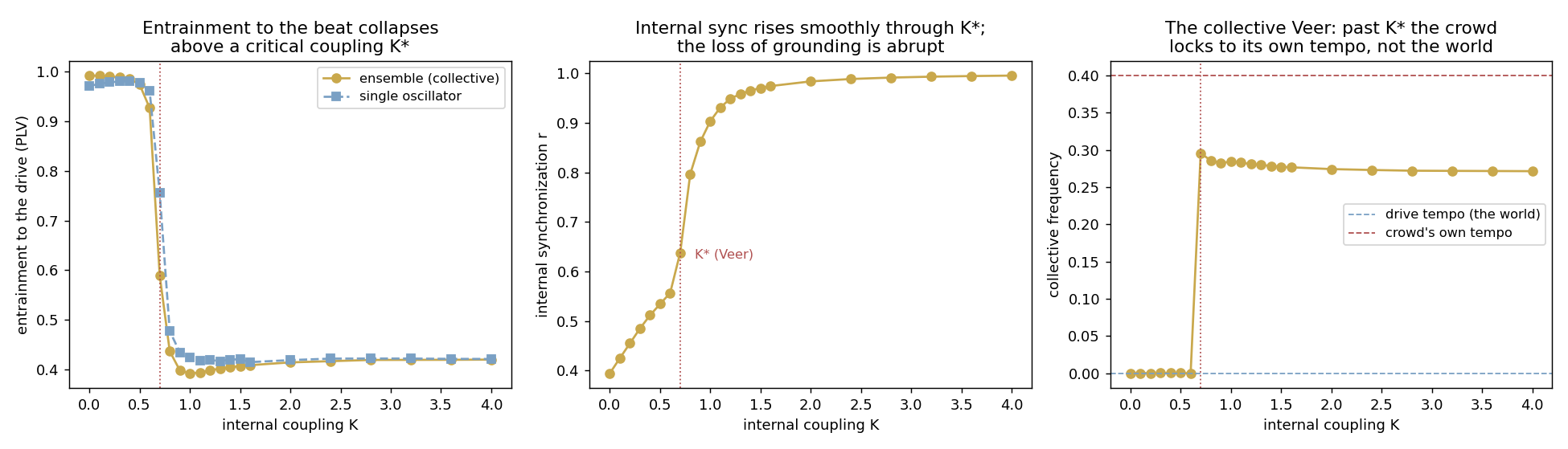
This is the [I+I] Veer of the original Veer appendix, promoted to collective scale. There, two instruments with no live channel accumulate confident, ungrounded structure. Here, a crowd with too much internal coupling accumulates confident, ungrounded consensus. Same failure, same signature — rising internal certainty, severed external grounding — now as a sharp phase transition in a tunable parameter. The names this wears in the wild: groupthink, echo chamber, a dancefloor so locked into itself it stops following the DJ, a field so internally coherent it stops reading its data.
Why this sharpens the framework rather than just illustrating it
The existing Pulse as Coupling appendix argues, correctly for the two-body case (sensor ↔ bell), that above a critical coupling κ_c the loop synchronizes and recognition becomes available — more coupling is good. This simulation shows that the N-body collective has the opposite danger at the top end: above a second critical coupling K*, internal locking destroys external grounding. The collective loop therefore has a coupling window, not a threshold:
- too little internal coupling — for a strong drive, the world still entrains the crowd (low-K is fine here); for a subthreshold drive, an incoherent crowd cannot amplify it at all (the regime where the classic edge-of-criticality peak would appear; see honest edge);
- too much internal coupling — the collective Veer: the crowd locks to a tempo of its own, and the world can drag that tempo but not capture it.
The alive collective lives below K*. The asymmetry principle reappears here dynamically: full internal synchronization is the collective version of the equivalence case the Asymmetric Synergy Bound calls sterile — everyone identical, perfectly redundant, and now demonstrably decoupled from the territory.
What the model does
- N = 120 oscillators, natural frequencies drawn around a crowd tempo
CROWD_DETUNE= 0.4, detuned from the drive at 0. - Drive: a steady external beat. Each oscillator feels it weakly (
EPS= 0.28) — strong enough to entrain a loose crowd, too weak to capture a self-locked one. - Euler–Maruyama integration with phase noise; burn-in discarded; phase-locking value (PLV) and collective frequency measured over a long sample window. Deterministic under
SEED.
Honest edge
This is one mean-field regime, and the result is parameter-dependent — which parameters, and how, is the substance:
- The transition is robust; the interior "edge-of-synchronization peak" is not what this regime shows. I set out to demonstrate the stronger claim — that collective recognition is maximized at an interior critical coupling, low and high coupling both failing. With a moderately strong drive (as here) the world entrains a loose crowd perfectly well, so entrainment is flat-high below K* and there is no low-K failure: the only failure is over-coupling. The interior peak requires a genuinely subthreshold drive that no loosely-coupled crowd can track, amplified only by the diverging susceptibility near the synchronization critical point. That regime is real in the forced-Kuramoto / collective-sensing literature but delicate to exhibit cleanly in a finite mean-field sweep; several attempts here collapsed into estimator noise. Claimed: the collective-Veer transition. Conjectured, not shown here: the interior optimum.
- Mean-field, all-to-all coupling. Real crowds and networks have structure (neighborhoods, hubs). Network topology changes K* and can smear the transition; nothing here addresses it.
- PLV and collective frequency are the robust observables. Information-theoretic measures (mutual information between the ensemble and the drive) were tried first and were dominated by a cancellation artifact — incoherent oscillators contribute nothing to the order parameter, so a coherent minority can make the ensemble look entrained at low K. PLV-to-the-drive and the collective frequency avoid that and are what the figure reports.
The result is therefore not "the framework predicted X and X is confirmed." It is: a defined, tunable model of the collective loop exhibits a sharp transition into the framework's own failure mode (the Veer) at a critical internal coupling, and that transition refines a published appendix's monotonic "more coupling is better" reading into a coupling window. The prettier interior-peak claim is named honestly as the harder, still-open version.
Run it
The model is one Python file: collective_loop.py. This copy writes its figure beside the script.
python3 -m pip install numpy matplotlib
python3 collective_loop.py
Deterministic under SEED = 11. Raise EPS and the crowd entrains at all K (no Veer); lower it toward the subthreshold regime to probe the interior-peak conjecture; raise CROWD_DETUNE to push K* down.