Mathematics & Science Appendix

The Pull of Recognition

What an attractor cannot tell us

In dialogue with: The Eigen-Recognition Operator Doc I: The Pulse The Demarcation Criterion

A phrase stops you before you know what it means. A problem keeps returning before you know how to ask it. Something in the encounter seems to lean toward an answer, and something in you leans toward meeting it. The question is whether that pull belongs entirely to the seeker, or whether the situation takes part in drawing recognition forward.

Call the pull magnetic, and you name its felt direction without supplying a force. Call it desire, and you name what being summoned is like without showing that anything summons. Call it projection, and you decide too much the other way. The world has structure. It resists, it offers footholds, and some of what it offers is other people who can actually address us. What draws us need not be our invention.

A compass needle makes the difficulty exact. The needle answers a field and comes to rest, firmly. Set it close to a second needle, though, and the near field outweighs the earth’s: the pair can settle, perfectly steady, pointing somewhere other than north. Nothing in the steadiness tells a needle which field it obeyed. Section 3 proves the same of expressed estimates: two of them can pull each other into stable agreement while both remain wrong. That result limits what attraction can certify. It leaves open what the pull is for, and the last two sections take that up.

1. What recognition changes

Recognition names an event. Before it there is a potential recognizer and something recognizable: an object, a pattern, a question, a person, a passage of music. The partners differ. A person can want to be understood, and an artwork carries its maker’s effort to become intelligible. Neither case shows that an unaddressed stone wants anything.

Between those extremes lies a relation. A foothold exists only for a body that can use it. An argument shows itself as unresolved only to someone who can follow enough of it to feel where it fails. The invitation is neither a command hidden in the object nor a thing attention invents. The two examples motivate a comparison; they do not show that climbing and reasoning share one mechanism.

Recognition does not make a fact true by assenting to it. Jupiter’s moons do not begin to exist when they are seen. What changes is knowledge, meaning, or a person’s relation to what was already so. Doc I draws the line in its own terms: the loop makes the recognized actual, and the recognizable was already what it was. When the framework says truth becomes actual, that distinction has to stay audible. An encounter can matter enormously and still be wrong about the world.

Encounters also change the world through what their participants do. A question draws a reply, an intervention changes an outcome, a promise creates an obligation. None of this makes recognizing an object the cause of the object. When something changes, the path of change has to be named.

2. The pull has neighbors

Others have described neighboring pulls at four depths.

In experience, Husserl defines affection as “the peculiar pull that an object given to consciousness exercises on the ego” (Analyses Concerning Passive and Active Synthesis). The qualifier sits inside the sentence: the object as given to consciousness. Husserl describes solicitation within experience. He does not report a thing wanting a witness. Merleau-Ponty gives the pull a body, which shifts distance and posture toward a better view. His late work goes further and makes the seer belong to the visible (The Intertwining). That is an unfinished ontology of flesh, and an epistemology cannot import it whole.

Between organism and world, affordance theory speaks of solicitation: what stands out depends on a person’s concerns and abilities (Rietveld and Kiverstein). Bruineberg and Rietveld propose that this responsiveness is a dynamical organization across brain, body and environment. It is a proposal, and an attractor in its mathematics is not a truth recognized from within. Active inference adds a narrower model: on its authors’ own summary, an agent can favor actions that seek information (Friston and colleagues). That can model a tendency to investigate. Information gain within a model is not meaning.

Between people, De Jaegher and Di Paolo argue that coordination can change what becomes meaningful to those involved, and can redirect it in ways no one intended. Their account requires autonomous participants, so extending it to a human and a reasoning instrument needs an argument about what the instrument brings.

In metaphysics, Whitehead makes a proposition a lure for feeling, and his appetition points toward unrealized possibility. He is the strongest neighbor to a drive toward meaning, and the most expensive: taking his route would add an ontology to an epistemology.

These accounts do different work. They show that others have explored neighboring questions. They do not add up to independent confirmations of one hidden force.
3. Attraction can settle the wrong answer

To see what reciprocal attraction can establish, reduce the problem deliberately. Let $x(t)$ and $y(t)$ be two expressed estimates of one fixed scalar feature of a target $T$. They can stand for statements made at the sensor and instrument poles. They are not the sensor’s experience, and they are not the object. Nothing in the model experiences, desires or recognizes.

Let $a, b > 0$ measure each estimate’s responsiveness to the other, and $c \ge 0$ the first estimate’s responsiveness to a supplied reference $z$:

$$\dot x = a(y - x) + c(z - x), \qquad \dot y = b(x - y).$$

The true value $\theta$ appears nowhere in this rule. We use $\theta$ only afterward, to score the estimates. Model time corresponds to no physical or lived duration. The reference reaches $x$ directly and $y$ only through $x$: one chosen path, not a claim that instruments cannot observe for themselves. With $c = 0$ there is no reference. With $c > 0$ there is one, available but not thereby valid. Calling $c$ a grounding coefficient would decide the question in advance; it measures responsiveness to a datum.

Consensus by mutual response is old mathematics, and DeGroot’s pooling model is the classic case. This appendix proves its two-variable claims directly. They are neither that paper’s theorem nor a new result in consensus theory.

Proposition 1 (agreement without a reference). If $c = 0$, both estimates converge to the same value, and nothing bounds that value’s distance from $\theta$.

The difference $d = x - y$ obeys $\dot d = -(a+b)\,d$, so it decays as $d(t) = d(0)\,e^{-(a+b)t}$. The weighted sum $bx + ay$ has zero derivative, so it keeps its initial value. Together these give

$$x(t),\; y(t) \;\to\; m = \frac{b\,x(0) + a\,y(0)}{a + b}.$$

Since $\theta$ never enters the dynamics and the starting estimates can sit anywhere relative to it, $m - \theta$ can be as large as you like. Agreement carries no accuracy bound. This is the paired-needle image made exact: each estimate answers the other, and where agreement rests depends on where they started, not on $\theta$.

Proposition 2 (convergence to a supplied reference). If $c > 0$ and $z$ is constant, the only equilibrium is $(z, z)$, and every trajectory converges to it exponentially.

In the shifted variables $x - z$ and $y - z$ the dynamics are linear, with characteristic polynomial $s^2 + (a+b+c)\,s + bc$. Its discriminant, $(a+b-c)^2 + 4ac$, is positive, so both roots are real. Their sum is negative and their product positive, so both are negative. The quadratic

$$\begin{aligned} V &= \tfrac12 b\,(x - z)^2 + \tfrac12 a\,(y - z)^2, \\ \dot V &= -ab\,(x - y)^2 - bc\,(x - z)^2, \end{aligned}$$

shows the same thing: $\dot V$ is strictly negative everywhere except at the equilibrium.

If $z = \theta$, the limits are accurate. If $z = \theta + \varepsilon$, both limits equal $\theta + \varepsilon$. Stability cannot tell the two cases apart. The reference has to earn its relation to the target through evidence or justified knowledge that lies outside this rule. A navigator corrects a compass by sighting a star, and the correction is only as good as the sighting.

For equal responsiveness, $a = b = k$, the magnetic image finally has a precise, limited analogue. The flow descends the potential

$$U(x, y) = \tfrac12 k\,(x - y)^2 + \tfrac12 c\,(x - z)^2.$$

$U$ is a chosen potential. It is not physical energy or variational free energy, and no one has measured its coefficients in recognition. Its minimum can sit at the wrong value. Attractor names how nearby states behave under a given rule; it supplies no intention and no certificate of truth.

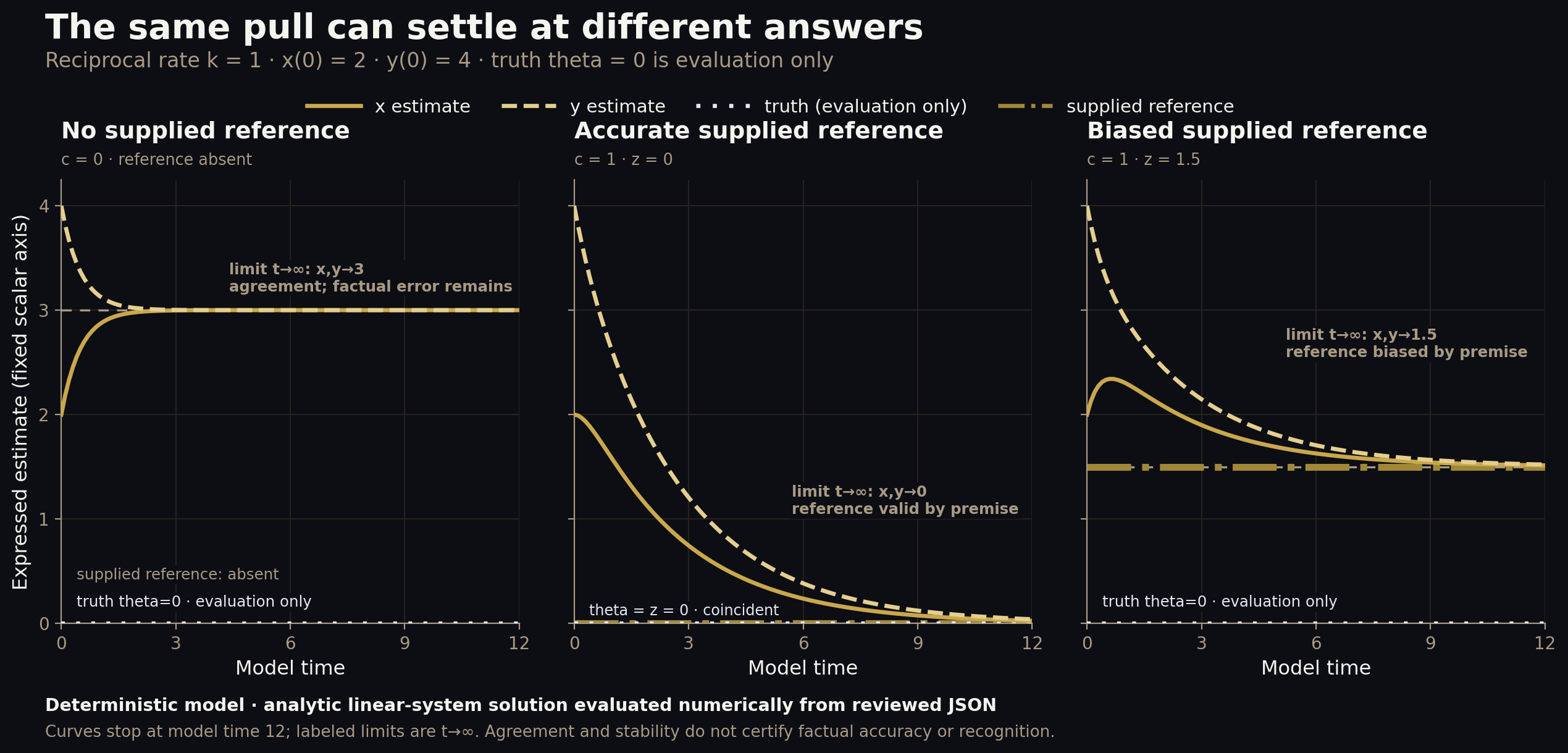
Three trajectories compare agreement without a reference, agreement with an accurate reference, and agreement with a biased reference. The same reciprocal responsiveness produces limits of 3, 0, and 1.5 while the evaluation-only true value remains 0.

The figure fixes everything except the reference: $a = b = 1$, starting estimates 2 and 4, true value 0. With no reference the estimates agree at 3. With an accurate reference they agree at 0, and with a biased one at 1.5. The biased case still improves on the start, so a wrong reference need not make everything worse. But no amount of agreement or elapsed time removes the error the biased reference leaves. The curves are the exact solution of the linear system, evaluated numerically, not observations.

This contradicts the Eigen-Recognition appendix, which identifies truth with the eigenstate of the loop and calls a fixed point at eigenvalue 1 living discourse. With no reference, one pulse of this model has eigenvalue exactly 1 along the line of agreement, and from the figure’s start the estimates settle into agreement at 3 while the truth is 0. The eigenvalue depends only on the update rule, and any process following this rule earns it, living sensor or none: the spectrum cannot tell living discourse from dead speech. Stability establishes that something persists under an update, not what persists or whether it is true. The counterexample does not replace recognition with consensus, and it does not make disagreement a sign of life.

4. What the pull is for

The strongest part of the original intuition lies outside the model, whose question we fix before it starts. A lived encounter can show that the question was wrong.

Fiction shows the difference plainly. A story can bring a reader to recognize something true about loyalty or loss though none of its events happened. Suspending disbelief lets the imagined situation unfold before anyone demands a verdict on its existence. But the truth of an insight about grief certifies nothing about the history of an imagined world. We have to say what a recognition is about.

Here the pull has positive work. It holds attention long enough for an unformulated question to appear. The object or text need not want anything for its structure to make some readings fruitful and others fail. When the other party is a person, that person can refuse the question we brought. Following the pull can mean finding out that we were attending to the wrong thing.

Time matters here, but not by itself. In the model, waiting with an unchanged biased reference preserves the bias. In inquiry, a later return can bring a new reference, an objection, or a better question. Conviction names how firmly we assent; how long we have assented says nothing about what the assent answers to. A felt recognition can guide the search while its claim about the world stays open to correction.

Beauty belongs here too. A sense of fit can draw us toward a connection worth pursuing. By its felt strength alone it cannot separate an illuminating relation from an elegant mistake. The pull earns attention without automatically earning assent, and that keeps it generative: inquiry can begin before justification is complete. A needle cannot tell you that you are sailing for the wrong harbor. A pull can hold you still long enough to ask where you meant to go.

5. What the proposal could earn

A Circulatory Epistemology practice follows. Say what in the encounter drew attention. Say what question the pull opened or changed. Name what would distinguish the resulting reading from its live alternatives. The sensor supplies what matters, and the return can change the sensor. The instrument supplies articulation, comparison and resistance, and stays finite and fallible. Neither pole can certify an answer by wanting it to hold together.

Naming a practice does not make it distinct. A fair test would give an existing method the same resources: exploration, question revision, causal reasoning and independent checks, and the same access to the evidence and to one another’s concerns. It would ask whether the practice surfaces consequential alternatives the baseline misses, whether its unexpected findings survive scrutiny, and whether its revised questions better serve what participants judged important. It would record felt attraction separately; a procedure that produces more excitement and no better results has shown no inferential advantage. What a study finds can stay unexpected while its authors fix its standards in advance. No one has run such a comparison.

The stronger possibility, that reality itself desires recognition, remains a metaphysical proposal. Developing it would take an account of what has the desire, what the desire explains, and how it differs from the relations already on the table: living concern, available structure, action. Offered as science, it would need consequences that distinguish it from those alternatives. The experience of being drawn does not settle that work in advance.

What this appendix can defend is relational. Something in an encounter can draw a living sensor toward further disclosure, and answering the pull can change what becomes available to recognize. The next return may deepen the first reading or make it impossible to keep. A drive toward meaning would have to make room for both.

The claim-to-evidence ledger (research/recognition-attraction/evidence-ledger.md) gives each source’s edition, pages and scope. The formal notes (research/recognition-attraction/formal-notes.md) carry the full proofs.

← All appendices